Skip to main content

 RapiTest - Functional testing
 RapiCover - Coverage analysis
 RapiTime - Timing analysis
 RapiTask - RTOS scheduling visualization
 RVS Qualification Kits - Tool qualification for DO-178C
 RapiCouplingPreview - DCCC analysis
 MACH178 Core Pack - Getting started
 MACH178 Platform Pack - Platform evaluation
 MACH178 Resource Pack - Interference verification
 MACH178 Qualification Pack- Tool qualification
 Tool Integration
 Training
 Consultancy
 Support
 RTBx - The ultimate data logging solution
 Sim68020 - Motorola 68020 Simulation
 Women in Tech Week - Elaine Batchelor on why soft skills matter and building quality teams from scratch
 Women in Tech Week - Zoë Stephenson on on 25 years in tech, high-integrity software and making quality happen
 Women in Tech Week - Hannah Jolly on making RVS easy and why representation matters
 Women in Tech Week - Lily Gaunt on Roblox, real-world code and building cool things
 Introduction to Data Coupling and Control Coupling for DO-178C
 The Evolution of DO-178 and ED-12 Standards
 Retro gaming with the Sim68020
 RVS gets a new timing analysis engine
 How to achieve multicore DO-178C certification with Rapita Systems
 How to achieve DO-178C certification with Rapita Systems
 Certifying Unmanned Aircraft Systems
 DO-278A Guidance: Introduction to RTCA DO-278 approval
 Multicore Software Verification and Certification Training (Langton Aerospace Technology)
 Supporting Multicore Interference Analysis using Branch Traces









Infineon® is the world’s second largest chip supplier to the automotive industry, serving automotive applications such as power, body and convenience, safety management and infotainment.
The PRO-SILTM Concept is a range of services provided by Infineon to support customers developing applications to meet IEC 61508 or ISO 26262. These services include safety drivers called SafeTCoreTM. These drivers are functionally independent of microcontroller hardware and can run on all microcontrollers in Infineon’s TriCoreTM family.
Infineon asked Rapita to conduct a two-stage project on the timing correctness of SafeTCore drivers:
Summary
The challenge
- To provide guaranteed WCET with minimal pessimism for SafeTCore drivers running on Infineon’s TriCore family in a system with limited I/O.
The solution
- Using RapiTime’s idpack feature, and a logic analyzer to collect timing data, full timing analysis of the software was performed.
The benefits
- Coverage analysis shows completeness of tests. RapiTime’s optimization support identified optimizations allowing WCET of specific functions to be reduced to 56% of its original value.
The challenge
Since the SafeTCore is not only dealing with functional safety but also timing safety, deadlines are being monitored and it is vital that the SafeTCore is able to provide guarantees about its own execution time requirements.
The SafeTCore software must have a low execution time so that there is sufficient time for the application to run within each frame. If the SafeTCore driver execution time is too long, then it becomes necessary to schedule some tests over multiple frames leading to a significantly longer response time for error detection.
The solution
Infineon selected RapiTime for its ability to provide a hybrid static analysis/dynamic measurement approach to WCET analysis. This avoided the challenges of a purely static analysis technique, which relies upon a specific model for each target to be analyzed.
As well as obtaining WCET values from RapiTime, Infineon recognized that it could derive other benefits from the use of a tool that measures timing for small blocks of source code. In particular, feedback is received on the software implementation quality with respect to temporal variability and optimization potential.
Using RapiTime’s idpack technology meant it was possible to uniquely identify as many instrumentation points as necessary within an 8-bit value. A trace of timestamped Ipoints was collected from an 8-bit output port using a Tektronix® Logic Analyzer.
The benefits
The timing analysis part of the case study concentrated on five TriCore functions. The chart below shows the difference in WCET between the initial versions and optimized functions, showing up to 43.9% reduction in WCET.
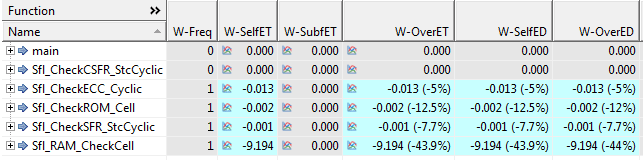
The timing measurements obtained for the WCET analysis were also used to find source code optimizations in parallel with providing evidence of meeting timing requirements.
Beyond the high potential for software optimization revealed by the WCET analysis, it was also possible to identify areas of the software for further review. For example, unexpectedly long execution times can point to an unexpected error condition being triggered.
Where RapiTime showed a large difference between maximum and calculated worst-case times, the cause was quickly identified as a data-dependent algorithm. This information is valuable when providing rationale for design and implementation decisions of future software.