Skip to main content

 RapiTest - Functional testing
 RapiCover - Coverage analysis
 RapiTime - Timing analysis
 RapiTask - RTOS scheduling visualization
 RVS Qualification Kits - Tool qualification for DO-178C
 RapiCouplingPreview - DCCC analysis
 MACH178 Core Pack - Getting started
 MACH178 Platform Pack - Platform evaluation
 MACH178 Resource Pack - Interference verification
 MACH178 Qualification Pack- Tool qualification
 Tool Integration
 Training
 Consultancy
 Support
 RTBx - The ultimate data logging solution
 Sim68020 - Motorola 68020 Simulation
 Women in Tech Week - Elaine Batchelor on why soft skills matter and building quality teams from scratch
 Women in Tech Week - Zoë Stephenson on on 25 years in tech, high-integrity software and making quality happen
 Women in Tech Week - Hannah Jolly on making RVS easy and why representation matters
 Women in Tech Week - Lily Gaunt on Roblox, real-world code and building cool things
 Introduction to Data Coupling and Control Coupling for DO-178C
 The Evolution of DO-178 and ED-12 Standards
 Retro gaming with the Sim68020
 RVS gets a new timing analysis engine
 How to achieve multicore DO-178C certification with Rapita Systems
 How to achieve DO-178C certification with Rapita Systems
 Certifying Unmanned Aircraft Systems
 DO-278A Guidance: Introduction to RTCA DO-278 approval
 Multicore Software Verification and Certification Training (Langton Aerospace Technology)
 Supporting Multicore Interference Analysis using Branch Traces
 Accelerating Testing and Certification with an AI-Driven Requirements Traceability Approach





On the 22nd of April, Rapita teamed up with DDC-I, who produce the popular Deos RTOS, to deliver the "Out of the box solution for multicore analysis" webinar. The webinar showcased a brand new simplified integration and also how RapiDaemons can be used for multicore analysis.
A primary challenge designers of modern avionics systems face today is how to implement an efficient means of verifying multicore systems. Specifically, one of the more daunting multicore development tasks is to quantify and optimize an application’s worst-case execution times – especially in the context of multicore interference caused by applications running on other cores that share common resources (e.g. cache, memory, etc.). Up to now, most avionics companies have had to develop or integrate their own tooling for this capability.
Download the full recording here.
This webinar addresses this critical but basic multicore system need. Rapita Systems, developer of software tools for on-target verification, optimization and code coverage analysis of critical real-time embedded systems, and DDC-I, supplier of DO-178 certifiable software and tools for safety critical avionics software developers, partner to offer an ‘out-of-the-box’ integration combining DDC-I’s Deos (time and space partitioned RTOS) with Rapita’s RapiTime (on-target timing) and RapiTask (scheduling visualization and analysis). This not only works on traditional single-core deployments but also for multicore systems running Deos.
DDC-I has been refining Deos’s DAL-A multicore strategy and features for well over a decade, developing an RTOS that effectively addresses the objectives of CAST-32A. Deos’s use of advanced technologies – such as cache partitioning – enables greater performance to be harnessed in the multicore system, whilst also maintaining re-use and functional capabilities.
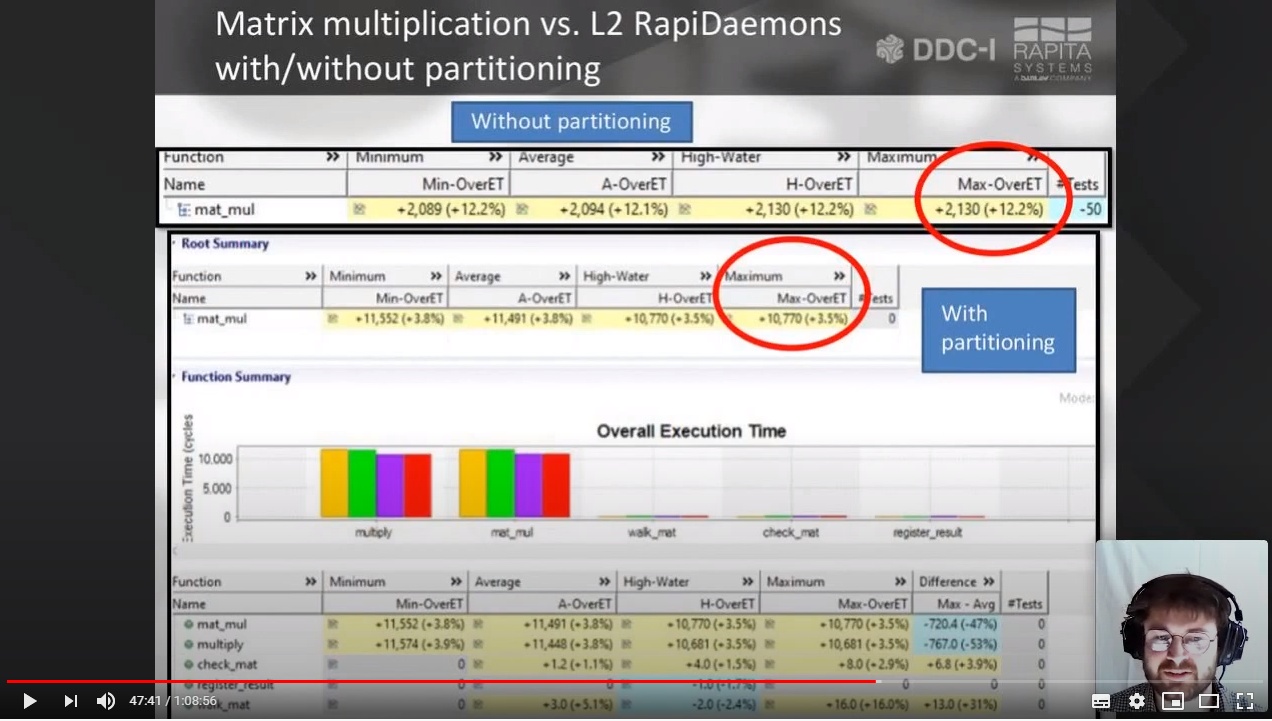
Rapita has worked closely with DDC-I to develop this seamless, hardware-agnostic integration of RVS with Deos, which is portable to every architecture supported by Deos (PowerPC, ARM, and x86). In this approach, tracing is accomplished by applying RVS instrumentation with a trace mechanism available within the Deos kernel. Further, RapiDaemons (interference generators) provide the means to simulate applications running on other cores and imposing upon shared resources. Together, all of these capabilities enable the integrator to qualify Deos-based multicore systems and determine how to best arrange multicore applications for optimal systems performance.
You can access the full recording here.
Rapita's research in multicore timing analysis has received funding from the European Union’s Horizon 2020 research and innovation programme under grant agreement No 878752.