Your browser does not support JavaScript! Skip to main content
Free 30-day trial DO-178C Handbook RapiCoupling Preview DO-178C Multicore Training Multicore Resources
Rapita Systems
 

Industry leading verification tools

Rapita Verification Suite (RVS)

RapiTest - Functional testing for critical software RapiCover - Low-overhead coverage analysis for critical software RapiTime - In-depth execution time analysis for critical software RapiTask - RTOS scheduling visualization RapiCoverZero - Zero-footprint coverage analysis RapiTimeZero - Zero-footprint timing analysis RapiTaskZero - Zero-footprint event-level scheduling analysis RVS Qualification Kits - Tool qualification for DO-178 B/C and ISO 26262 projects RapiCouplingPreview - DCCC analysis

Multicore Verification

MACH178 - Multicore Avionics Certification for High-integrity DO-178C projects

Other

RTBx - The ultimate data logging solution Sim68020 - Simulation for the Motorola 68020 microprocessor

RVS Software Policy

Software licensing Product life cycle policy RVS Assurance issue policy RVS development roadmap

Industry leading verification services

Engineering Services

Tool Integration Qualification Training Consultancy Support

Latest from Rapita HQ

Latest news

MACH178 Rapita Systems Launches Next Generation of MACH178 for Multicore
RVS 3.24 accelerates multicore software verification
Rapita Systems and Avionyx Announce Strategic Partnership to Offer Best-in-class Avionics Solutions
RVS 3.23 Launched
View News

Latest from the Rapita blog

Retro gaming with the Sim68020
RVS gets a new timing analysis engine
How to measure stack usage through stack painting with RapiTest
What does AMACC Rev B mean for multicore certification?
View Blog

Latest discovery pages

Processor How to achieve multicore DO-178C certification with Rapita Systems
Plane How to achieve DO-178C certification with Rapita Systems
Military Drone Certifying Unmanned Aircraft Systems
control_tower DO-278A Guidance: Introduction to RTCA DO-278 approval
View Discovery pages

Upcoming events

Certification Together International Conference (CTIC)
2026-06-17
HISC 2026
2026-10-13
View Events

Technical resources for industry professionals

Latest White papers

Mitigation of interference in multicore processors for A(M)C 20-193
Sysgo WP
Developing DO-178C and ED-12C-certifiable multicore software
DO178C Handbook
Efficient Verification Through the DO-178C Life Cycle
View White papers

Latest Videos

Multicore Avionics (Aerospace Innovations)
Certification-Ready Rust: GNAT Pro & RVS for Avionics Standards
Accelerated software verification with RVS 3.23
Getting started with RVS
View Videos

Latest Case studies

Case Study Front Cover
Multicore timing analysis support for ECSS-E-ST-40C R&D with MACH178
GMV case study front cover
GMV verify ISO26262 automotive software with RVS
Kappa: Verifying Airborne Video Systems for Air-to-Air Refueling using RVS
View Case studies

Other Resources

 Webinars

 Brochures

 Product briefs

 Technical notes

 Research projects

 Flyers

 Multicore resources

Discover Rapita

About us

The company menu

  • Customers
  • Partners & Distributors
  • Research projects
  • Contact us
  • Careers
  • Working at Rapita
  • Subscribe to newsletter

Industries

  Civil Aviation (DO-178C)   Military & Defense   Automotive (ISO 26262)   Space

Standards

  DO-178C   A(M)C 20-193

US office


info@rapitasystems.com Rapita Systems, Inc., 41131 Vincenti Ct., Novi, MI 48375, USA

UK office

+44 (0)1904 413945
info@rapitasystems.com Rapita Systems Ltd., Atlas House, Osbaldwick Link Road, York, YO10 3JB, UK

Spain office

+34 93 351 02 05
info@rapitasystems.com Rapita Systems S.L., Parc UPC, Edificio K2M, c/ Jordi Girona, 1-3, Barcelona 08034, Spain
Back to Top

Advanced multicore verification for modern avionics

The streamlined solution for certifying multicore avionics for A(M)C 20-193 and AA-22-01

Download BrochureContact us
  • Overview
  • Resources
  • Compatibility

MACH178

How does it help?

MACH178 provides a blueprint and supporting tools to support the use of multicore platforms in safety-critical software from planning to approval.

Provided as a set of Packs that layer capabilities, MACH178 helps define a certification approach, evaluate multicore platforms and configurations, and certify software in both single active core and multicore modes.

The solution helps organizations accelerate project timelines, reduce certification risk, and develop internal expertise to run multicore projects more efficiently.

EXPLORE MACH178

MACH178 Core Pack logo
MACH178 Platform Pack logo
MACH178 Resource Pack logo

MACH178

What does it include?

MACH178 includes guidance, tools and off-the-shelf certification evidence in packages designed to support you from early planning through to certification.

Some activities for certification must be performed on the final target configuration. MACH178 provides the guidance, tools and training needed for your organization or an accredited service partner to perform these activities on time and on budget.

THE SOLUTION FOR A(M)C 20-193, DO-178C & AA-22-01 CERTIFICATION

Multicore projects require compliance with guidance such as DO‑178C and A(M)C 20‑193. MACH178 products are built to help you meet these requirements throughout your project life cycle.

Objective Direct Support Consultancy + Guidance
MCP_Planning_1 ✓ ✓
MCP_Planning_2 ✓ ✓
MCP_Resource_Usage_1 ✓ ✓
MCP_Resource_Usage_2 N/A* N/A*
MCP_Resource_Usage_3 ✓ ✓
MCP_Resource_Usage_4 ✓ ✓
MCP_Software_1 ✓ ✓
MCP_Software_2† ✓ ✓
MCP_Error_Handling_1 ✓ ✓
MCP_Accomplishment_Summary ✓ ✓
Description Obj. Direct Support Consultancy + Guidance
Requirements-based testing 6.4.a-d ✓ ✓
Target computer Compatibility 6.4.e ✓ ✓
Correctness of test results 6.4.5.c ✓ ✓
Requirements coverage 6.4.4.a-b ✓ ✓
Structural coverage analysis 6.4.4.c ✓ ✓
DC/CC analysis 6.4.4.d ✓ ✓
Additional code verification 6.4.4.c ✓ ✓
Requirements traceability 6.3.1.f, 6.3.2.f ✓ ✓
Software partitioning integrity 6.3.3.f ✓ ✓
Source Code is accurate and consistent 6.3.4.f ✓ ✓

MACH178 also support related standards such as AMACC and AA-22-01.
*MCP_Resource_Usage_2 is a reserved objective from CAST-32A that is no longer required for A(M)C 20-193 compliance but is required by A(M)C 20-152A objective COTS-8.
†Support through RapiCoupling, scheduled for release H1 2027.

FLEXIBLE PACKAGES FOR YOUR USE CASE

MACH178 helps you define a methodology for certifying multicore based avionics systems to satisfy A(M)C 20-193, AA-22-01 and similar multicore certification objectives.

By providing template DO-178C planning document additions and verification procedures and checklists for both multicore and single active core projects, MACH178 helps you plan and document your certification approach in a fraction of the time.

The solution:

MACH178 Core Pack logo

Selecting the right platform and configuration has a huge impact on interference, verification, project timelines and risk.

MACH178 helps you make evidence-based decisions to evaluate hardware platforms and configurations against performance criteria and timing requirements.

The solution:

MACH178 Core Pack logo

If sufficient software performance can be achieved by running on a single active core, deactivating all but one core may be the preferred approach as it can eliminate the need to meet A(M)C 20-193 objectives when done correctly.

MACH178 helps confirm whether single active core is a viable approach for software by supporting performance benchmarking, and provides guidance on which core deactivation methods can be used to eliminate the need to meet A(M)C 20-193 objectives.

It also provides the software tools and qualification support needed to verify software for DO-178C objectives including requirements-based testing, structural coverage, worst-case execution time, and data and control coupling analyses.

The solution:

MACH178 Core Pack logo

Certifying software running in full multicore mode requires meeting additional objectives in guidance such as A(M)C 20-193 and AA-22-01.

MACH178 streamlines the path to multicore certification, providing guidance, tools, support and training to ensure efficient mitigation of interference and generation of certification evidence. It includes certification-ready artifacts to identify hardware resources, interference channels and critical configuration settings on a multicore processor, as well as tests that can be run on your platform configuration to verify the impact of multicore interference.

The solution:

MACH178 Core Pack logo

Product features

Multicore Certification Planning

AC 20-193 & AMC 20-193 objectives: MCP_Planning_1, MCP_Planning_2

People working on documents

MCP_Planning_1 applies to DAL A, B and C systems. For all software assurance levels, the platform must be described, including the hardware, peripherals, and the RTOS being used. For DAL A and B systems, plans should include information on the verification processes that will be followed to produce AMC 20-193 compliance evidence.

MCP_Planning_2 requires that you provide a description of how your multicore platform’s resources will be used, allocated and verified, identify any enabled dynamic hardware features, and identify the aspects of the multicore platform that require the use of a safety net.

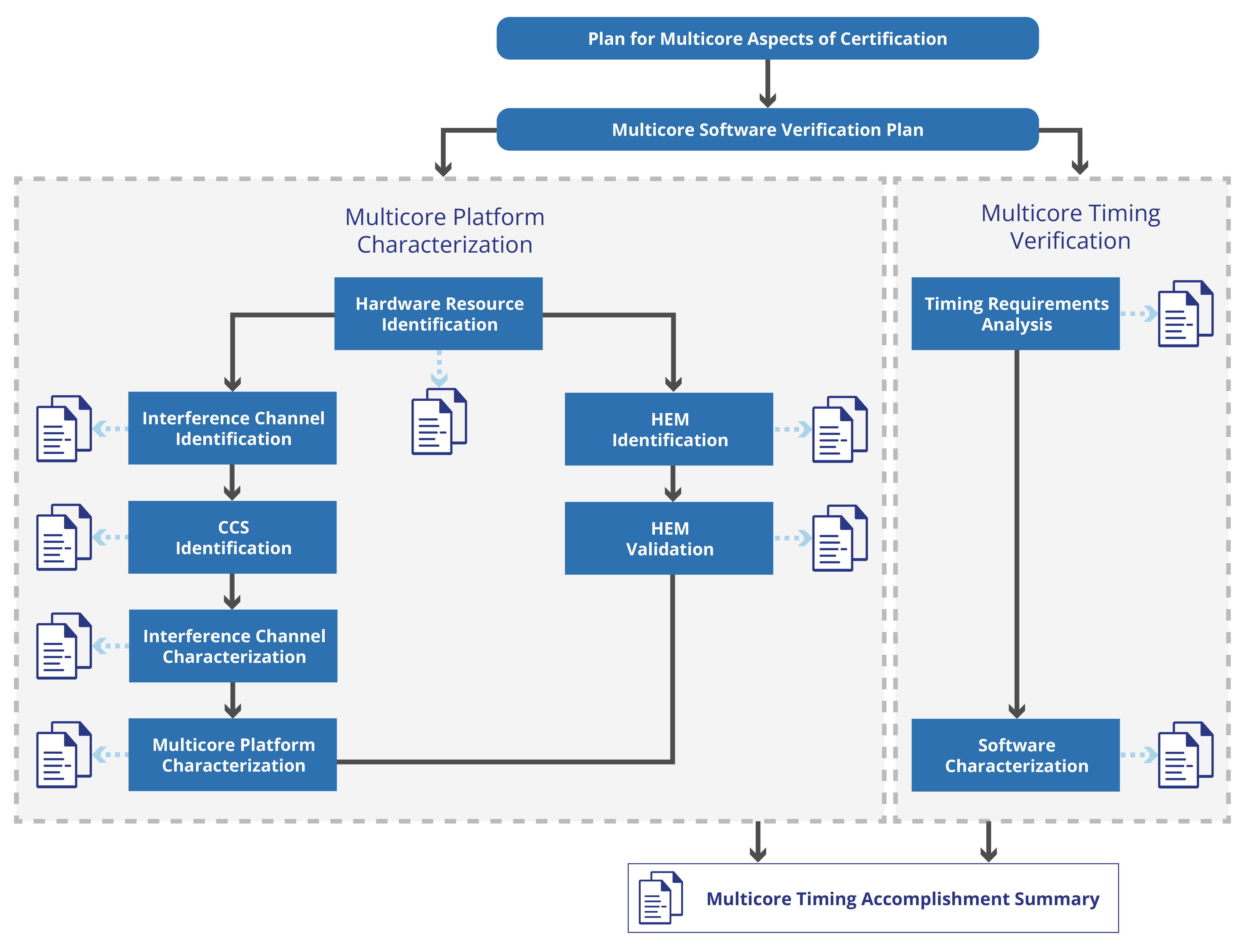
Rapita Systems’ MACH178 solution supports planning for A(M)C 20-193 projects. MACH178 Foundations, part of the MACH178 Core Pack, includes template plans and checklists to help you write up and review your plans. Specifically, it includes a template Plan for Multicore Aspects of Certification (PMAC) and Multicore Software Verification Plan (MSVP), which links to verification procedures also included in MACH178 Foundations. Rapita Systems also supports multicore certification planning through consultancy.

Close

Critical Configuration Settings Identification

AC 20-193 & AMC 20-193 objective: MCP_Resource_Usage_1

Person soldering

MCP_Resource_Usage_1 requires that you identify and document the MCP configuration settings that will enable the hardware and the software hosted on the MCP to satisfy the functional, performance, and timing requirements of the system.

Rapita Systems’ MACH178 solution supports meeting this objective. A procedure that you can follow to identify Critical Configuration Settings is included in MACH178 Foundations, which is part of the MACH178 Core Pack. This is used to identify the hardware registers that can be used to mitigate multicore interference on your platform . MACH178 Foundations also includes a template output and a checklist to ensure that the outputs have been reviewed. MACH178 Resource Packs include Critical Configuration Settings Reports for supported multicore platforms, which can be used directly for certification.  

Close

Protection of configuration integrity

AC 20-193 & AMC 20-193 objective: MCP_Resource_Usage_2

This objective was introduced in CAST-32A, but was not included in AC 20-193 and AMC 20-193 as it is already covered in AC 20-152A / AMC 20-152A objective COTS-8.

The objective asked for the applicant to implement a mechanism to detect and recover from inadvertent modifications to critical configuration settings.

Rapita Systems can help you identify critical configuration settings on your multicore platform, see MCP_Resource_Usage_1.
 

Close

Interference Channel Identification & Characterization

AC 20-193 & AMC 20-193 objective: MCP_Resource_Usage_3

Person going through documents

MCP_Resource_Usage_3 requires that you identify interference channels on your platform and verify any interference mitigation strategies you have deployed. This requires detailed understanding of the multicore platform and its resources, and access to detailed technical reference material about the architecture and behavior of multicore hardware.

Rapita Systems’ MACH178 solution supports meeting this objective. Procedures, templates and review checklists that you can follow to identify,  characterize and document interference channels on multicore platforms are available in MACH178 Foundations, which is part of the MACH178 Core Pack. 

Interference Channels that have been identified are documented in an Interference Channel Identification Report. Off-the-shelf reports are available for supported resources in Resource Packs. Characterization produces on-target results for multicore interference. This is supported by RVS tools, which are included in the MACH178 Core Pack, and characterization tests and RapiDaemons, which are available in Resource Packs for supported resources.

Where available, MACH178 Resource Packs include Interference Channel Identification Reports, RapiDaemons and to support Interference for specific hardware resources.

Close

Verification of resource capacity and usage

AC 20-193 & AMC 20-193 objectives: MCP_Resource_Usage_4

RapiTask

MCP_Resource_Usage_4 requires that you identify the capacity of hardware resources on your multicore processor and demonstrate that the software will not exceed this capacity.

Rapita Systems’ MACH178 solution supports meeting this objective. Automation tools including RVS, available in the MACH178 Core Pack facilitate the measurement of resource capacity and software resource usage. Guidance on achieving the objective is included in procedures, templates and checklists available in MACH178 Foundations, also part of the MACH178 Core Pack.
 

Close

Multicore WCET analysis

AC 20-193 & AMC 20-193 objective: MCP_Software_1

RapiTime report

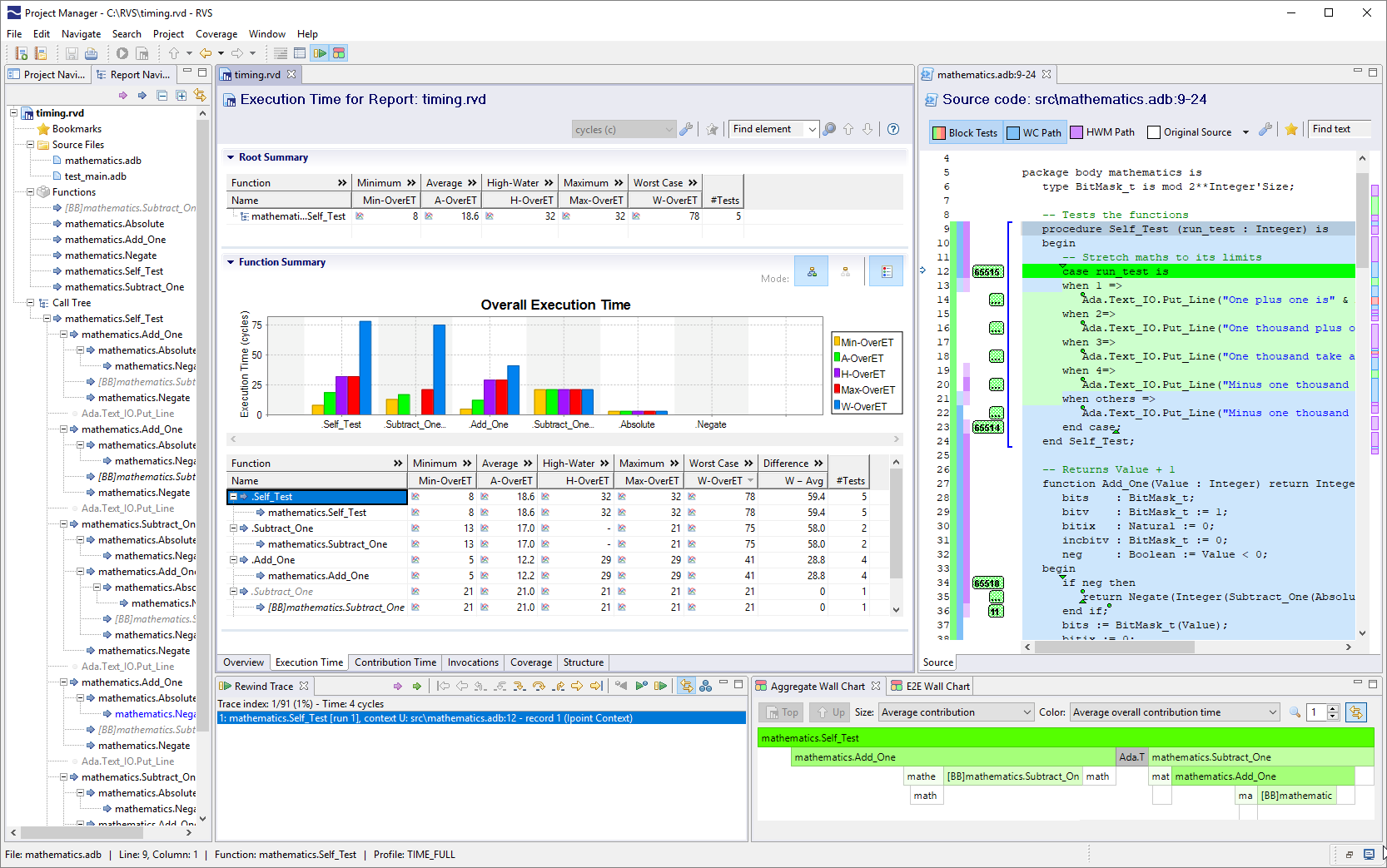
MCP_Software_1 requires that you verify that your software meets its timing deadlines in the multicore environment, including interference that can be encountered on the system. It is expected that you produce this evidence through on-target testing. This requires an environment in which interference can be generated in a repeatable fashion.

Rapita Systems’ MACH178 solution supports meeting this objective. MACH178 Foundations, included in the MACH178 Core Pack, provides guidance on selecting strategies for multicore WCET analysis, as well as results templates and checklists to support the activity. RVS tools, also included in the MACH178 Core Pack and Characterization RapiDaemons, included in Resource Packs for supported resources, support the collection of WCET evidence on-target. Rapita Systems can also provide consultancy to support the definition of WCET analysis methods for your multicore platform.
 

Close

Multicore Data coupling and control coupling analysis

AC 20-193 & AMC 20-193 objective: MCP_Software_2

RapiCoupling

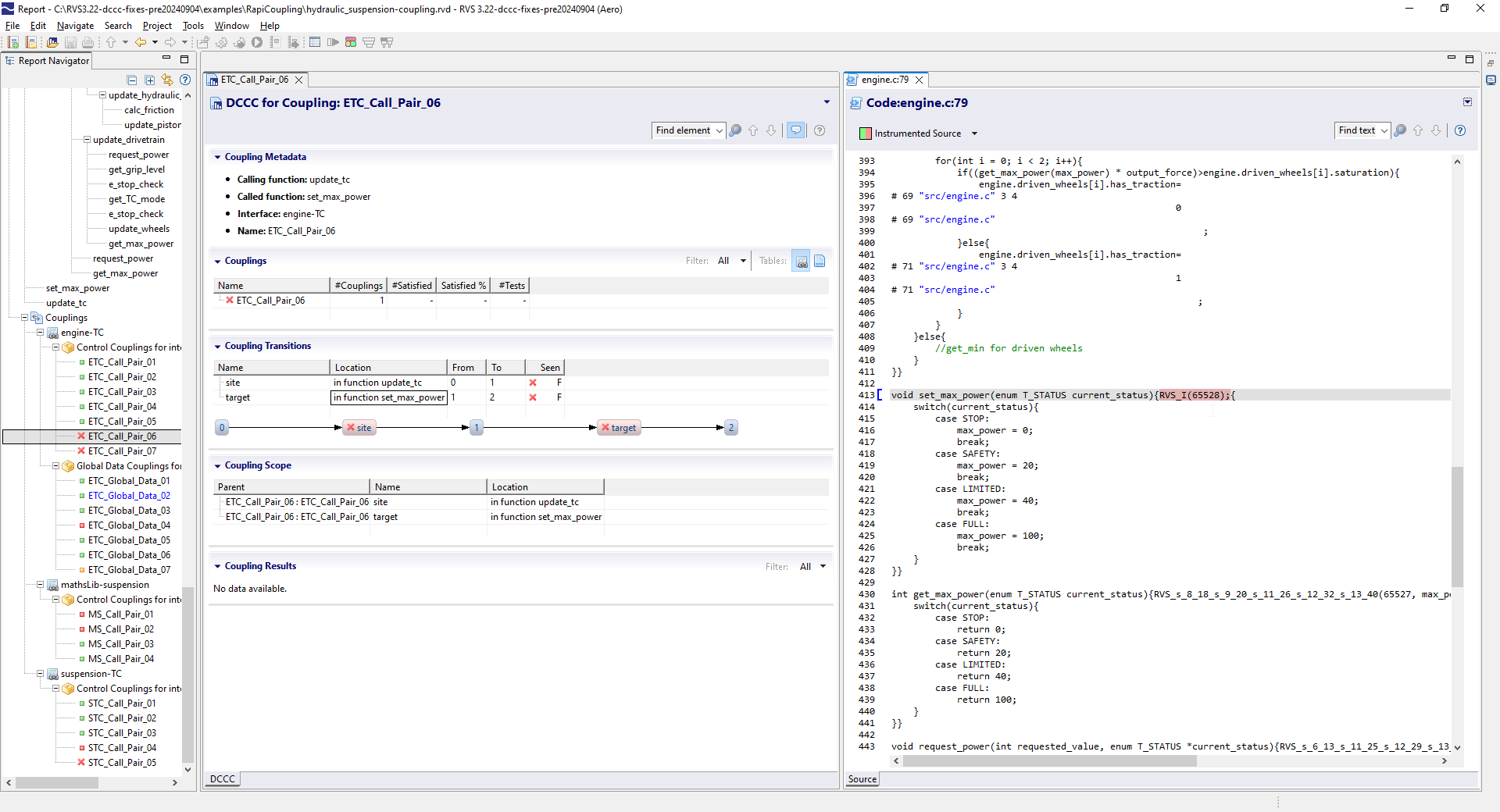
MCP_Software_2 requires that you verify the data coupling and control coupling (DCCC) of your multicore system. A wide range of perspectives exist on what DCCC means for single core systems, and several different analysis methods have been accepted when certifying DO-178C software. As of today, there is no one accepted method for performing DCCC analysis for multicore systems in line with AC 20-193 and AMC 20-193 objectives.

For single-core systems, DCCC analysis is bounded by coupling between components. A(M)C 20-193 specifically mentions that “Interference may occur between tasks of a single component when the tasks execute on different cores”, and implies that interference should be considered during DCCC verification.

While data coupling and control coupling analysis for multicore systems is of yet a little discussed topic, Rapita Systems lead the way in commercial solutions to multicore verification, and we can work with you to define a strategy that fits for your project.
Rapita Systems is developing in-depth, flexible support for DO-178C data and control coupling analysis through the RapiCoupling tool, which will include guidance on selecting criteria for the analysis and be included in the MACH178 Core Pack when available. A case study including use of the tool in collaboration with Collins Aerospace was presented at DASC 2024.

Close

Safety Nets

AC 20-193 & AMC 20-193 objective: MCP_Error_Handling_1

This objective asks the applicant to identify the effect of failures that may occur within the multicore platform, and demonstrate that detection and recovery mechanisms have been implemented where necessary.

Safety nets should be developed in line with the aircraft-level safety assessment.

Rapita Systems can help with the verification of a safety net implementation through automation tools and consultancy.
 

Close

Summarize verification results

AC 20-193 & AMC 20-193 objective: MCP_Accomplishment_Summary

Documents

Verification results generated to meet AC 20-193 and AMC 20-193 objectives should be summarized in an Accomplishment Summary.

This should include a high-level summary of results from all verification activities, traceability back to the plans, and a compliance matrix showing which results trace to which A(M)C 20-193 objectives.

Rapita Systems’ MACH178 solution provides support for generating an Accomplishment Summary to meet this objective. MACH178 Foundations and RVS, both included in the MACH178 Core Pack, provide guidance and automation support for generating accomplishment summaries for multicore verification projects.

Close

Requirements-based testing

DO-178C objectives: 6.4.a, 6.4.b, 6.4.c, 6.4.d

RVS running on a Laptop

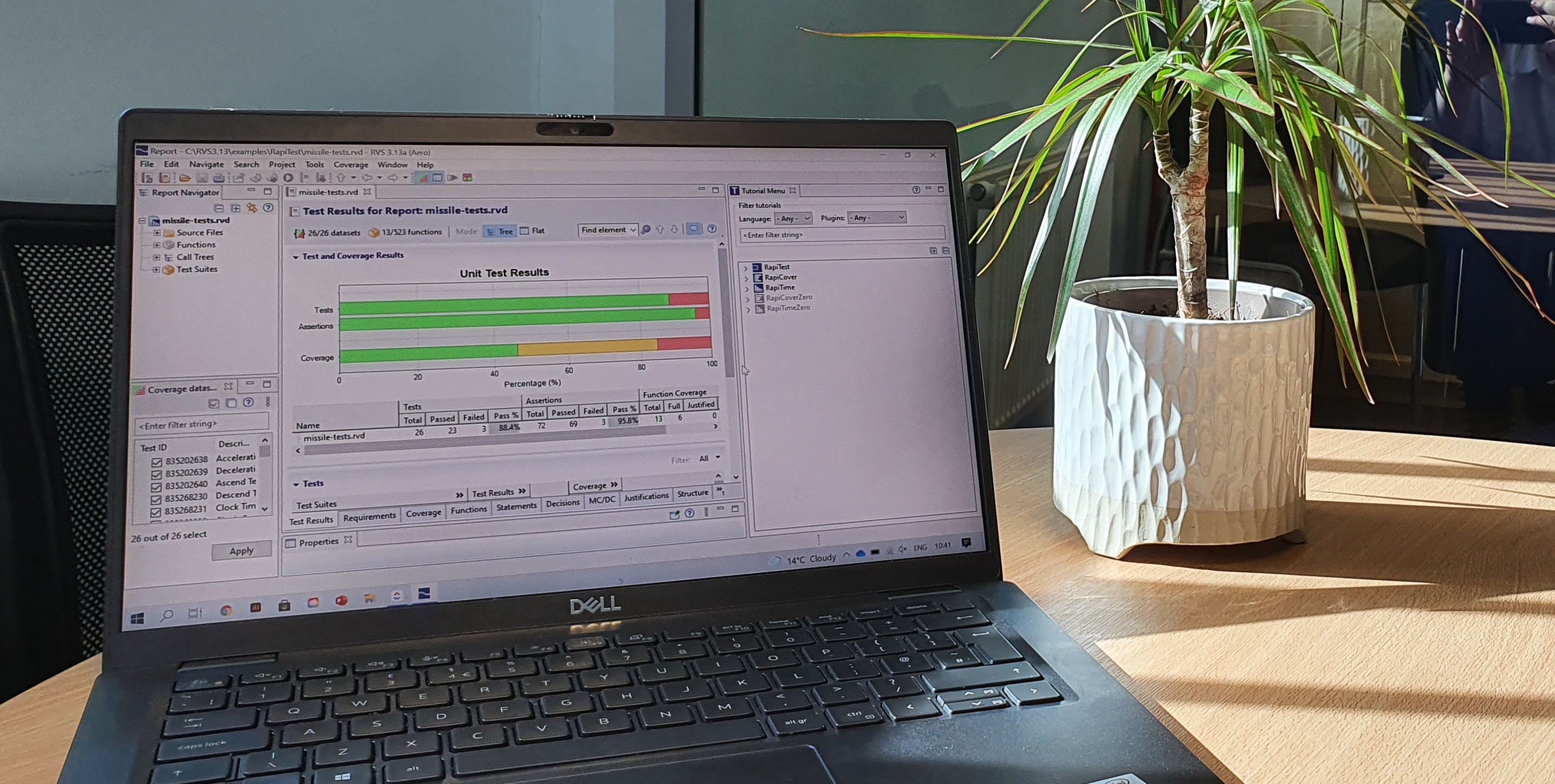
DO-178C objectives §6.4.a-d require testing of the code to ensure that it complies with and is robust with respect to high and low-level requirements.

DO-178C keeps the development and verification processes separate and requires levels of independence between them. Test environments often present tests as code, which can be challenging for test engineers to create and review while remaining independent from the development process.

RapiTest supports test authoring without requiring engineers to write any additional code. Its test steps and expressions reference the software's interface, not its implementation. The underlying integration is flexible and can provide test evidence on any embedded target. Rapita works with your organization to ensure a robust, qualifiable integration with which results can be collected from both on-host and on-target tests. Learn how RapiTest helped Kappa optronics produce DO-178C requirements-based test evidence in our case study.

If you’re looking for a V&V partner, we can help you produce DO-178C test evidence for your software by writing and executing requirements-based tests, either using your DO-178C processes or our own. See how we did this for Triumph Integrated Systems in our case study.

Close

Target computer compatibility

DO-178C objective: 6.4.e

Person soldering


“...execute the software to confirm that... the Executable Object Code is compatible with the target computer.”

RTCA DO-178C §6.4.e

This objective requires that selected tests, especially Hardware-Software Integration tests, are executed in the target computer environment. Challenges include harnessing low-level (component) tests in the target environment and retrieving outputs (test results) from that environment.

RapiTest lets you specify your test harness as stubs, runs, and checks, and executes the harness in a host, target, or simulated computer environment. Performing checks in that environment minimizes the required data transfer and helps to automate test evaluation and discrepancy analysis. All RVS tools are designed from the ground up to support on-target testing. Learn how RapiTest helped Kappa optronics produce DO-178C requirements-based test evidence on-target in our case study.

Rapita’s Target Integration Service and Qualified Target Integration Service ensure that a robust integration of RVS with the embedded target hardware is deployed and qualified. See how we delivered target and qualified target integrations services to Collins Aerospace in our case study.

Close

Test procedures are correct

DO-178C objective: 6.4.5.b

Person going through documents

We can provide V&V services to help you produce DO-178C test evidence for your software by writing and executing requirements-based tests, either using your DO-178C processes or our own. If we do, we perform the analysis needed to ensure that test procedures are correct. You can see how we produced DO-178C test evidence for Triumph Integrated Systems in our case study.

Close

Test results are correct and discrepancies explained

DO-178C objective: 6.4.5c

“...ensure that the test results are correct and that discrepancies between actual and expected results are explained.”

RTCA DO-178C §6.4.5.c (Table A-7 2)

This review shows that all tests either pass or fail with a well-understood and agreed justification. The challenge here is to efficiently gather the expected and actual results and check for discrepancies.

RapiTest allows you to define both the set-up actions and the correctness checks for each test. It executes those in the target computer. When a check fails, it provides the expected and actual results to show you the discrepancy. Learn how RapiTest helped Kappa optronics produce DO-178C requirements-based test evidence on-target in our case study.

We can provide V&V services to help you produce DO-178C test evidence for your software by writing and executing requirements-based tests, either using your DO-178C processes or our own. If we do, we perform the analysis needed to ensure that test results are correct and discrepancies are explained. You can see how we produced DO-178C test evidence for Triumph Integrated Systems in our case study.

Close

Requirements coverage

DO-178C objectives: 6.4.4.a, 6.4.4.b

ReqIF to RVS

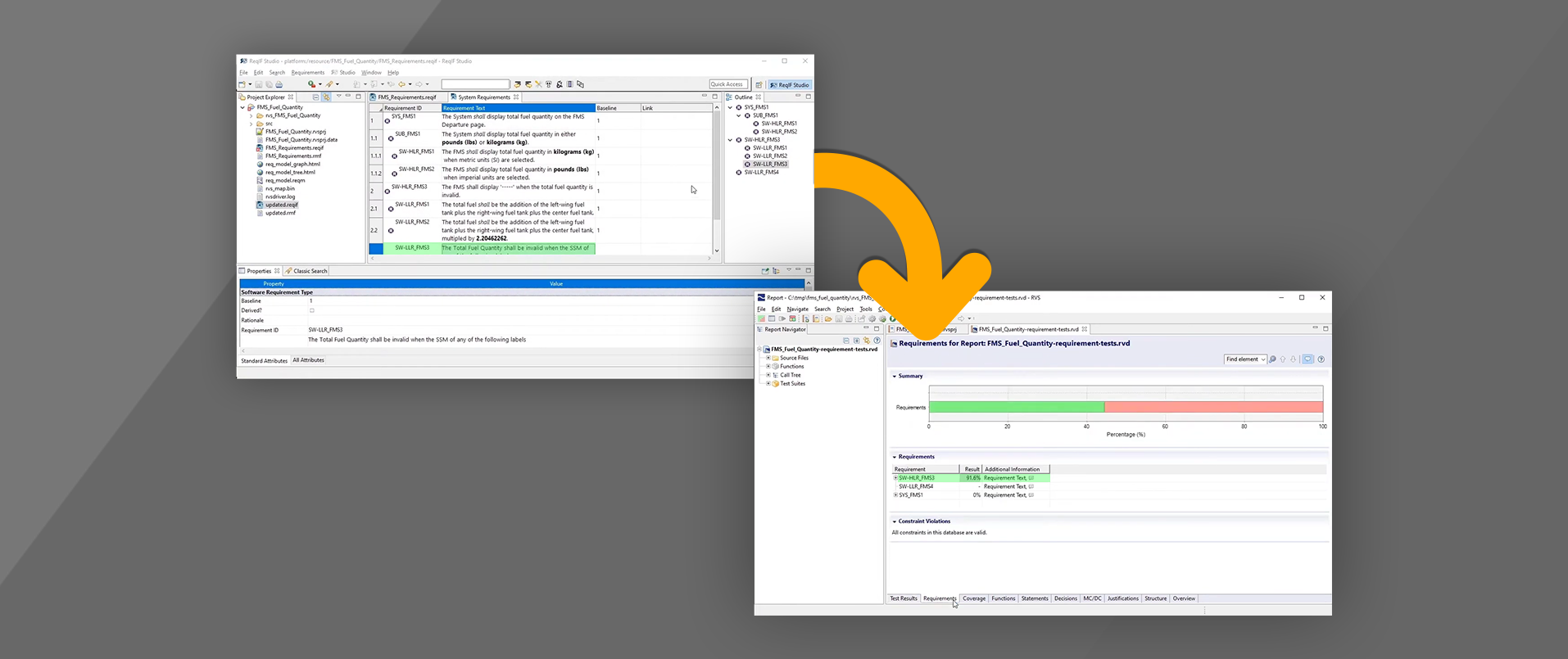
Traceability is crucial in DO-178C. It links corresponding items in different outputs such as requirements and tests. Challenges include ensuring that engineers can keep traceability information up to date when they make changes and consolidating the traceability information into a single view for presentation and review. Traceability is typically managed by dedicated requirements traceability tools.

RVS tools integrate with commonly used requirements traceability tools such as DOORS, Jama, Polarion and Visure, allowing traceability links to be maintained in a project throughout the project life cycle. Within RVS, traceability is maintained between, for example, test cases and associated structural coverage at the code level, and requirements coverage can be viewed when requirements have been imported from a requirements traceability tool.

We can provide V&V services to help you produce DO-178C test evidence for your software by writing and executing requirements-based tests, either using your DO-178C processes or our own. If we do, we perform the analysis needed to ensure that test procedures are correct. You can see how we produced DO-178C test evidence for Triumph Integrated Systems in our case study.

Close

Structural coverage analysis

DO-178C objectives: 6.4.4.c

RapiCover report

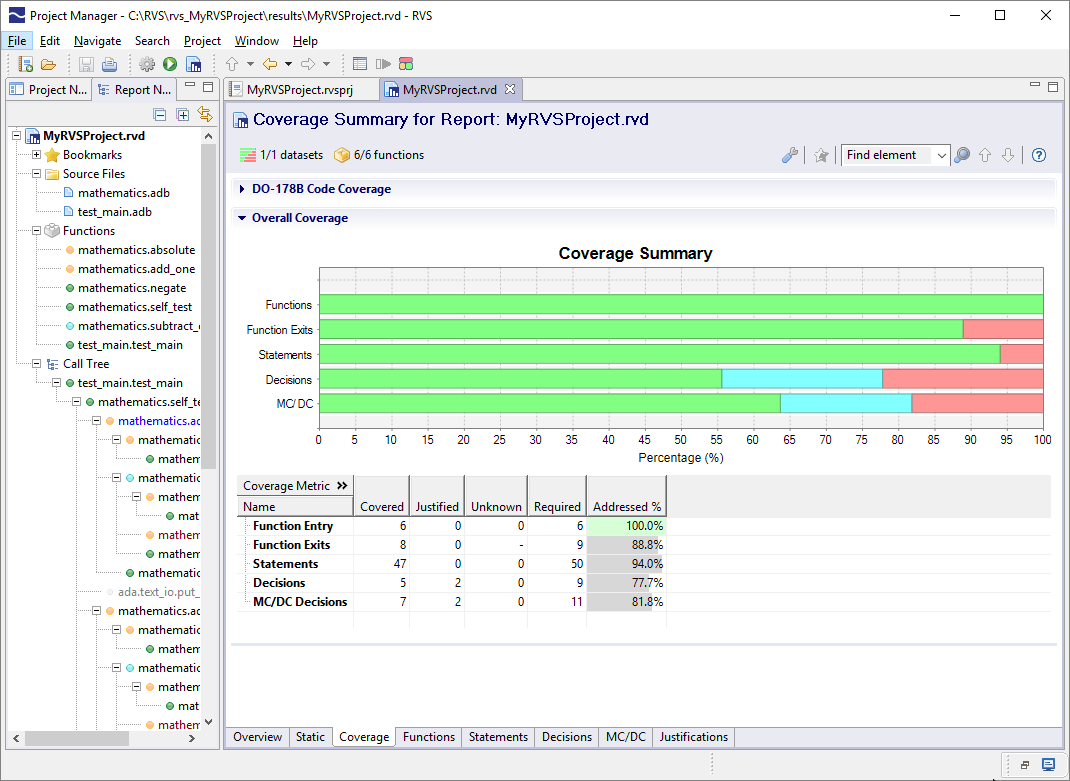
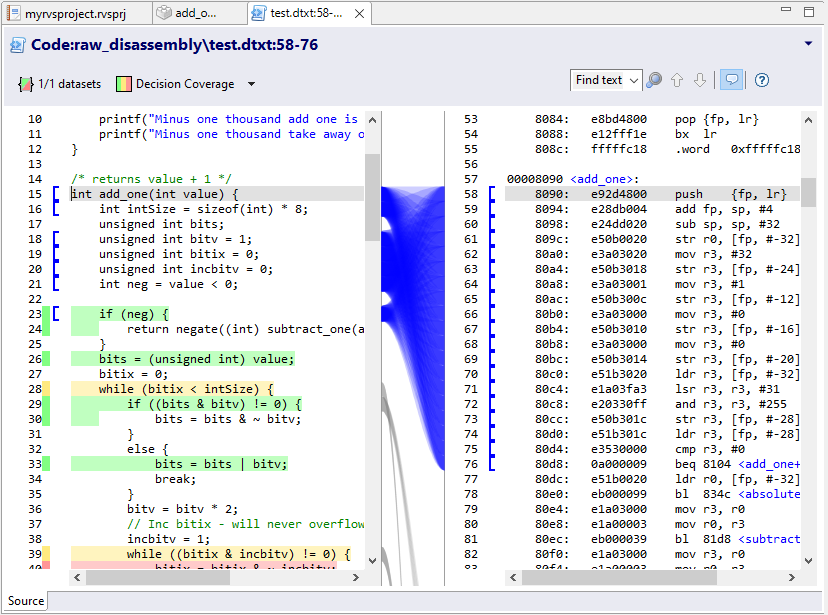
Structural coverage analysis (SCA) demonstrates that the code has been sufficiently tested, with the associated coverage criteria dependent on the software DAL. Structural coverage has to be obtained through requirements-based testing and can be obtained by analysis of either source code or object code coverage. The main challenges of SCA include instrumentation overheads for on-target testing, effort required to merge coverage from different test builds, and resolving incomplete structural coverage.

Rapita provides support for both source code and object code based structural coverage analysis through RapiCover and RapiCover Zero , respectively. RapiCover’s instrumentation overheads are significantly lower than competitor solutions, allowing coverage to be collected in fewer test builds, therefore reducing test overheads. Where different builds are still needed, results can be merged, and this feature is qualified. RapiCover justifications make it easy to mark code as covered by analysis to resolve coverage gaps, and support is available to migrate justifications when code changes. Unlike some competitor solutions, RapiCover’s instrumentation is qualified, so manual review of applied instrumentation is not required. See how we supported organizations such as Collins Aerospace and Cobham Aerospace Connectivity in their DO-178C structural coverage analysis in our case studies.

Close

Data coupling and control coupling coverage analysis

DO-178C objectives: 6.4.4.d

RapiCoupling

Data coupling and control coupling (DCCC) analysis allows integration errors to be identified earlier during the verification life cycle, which can increase software quality and reduce overall verification costs. There is no accepted industry-wide definition of the detailed analyses that are required to meet the objective, and until now, commercial automation tools have lacked the capability and flexibility to support the varying interpretations of DCCC analysis across the safety-critical avionics industry.

Rapita provide DCCC services and are developing in-depth, flexible support for DO-178C data and control coupling analysis through the upcoming RapiCoupling tool, which will include guidance on selecting criteria for the analysis. A case study including use of the tool in collaboration with Collins Aerospace was presented at DASC 2024. A public experimental version of the tool will be available in summer 2025.

Our DCCC services include working with you to determine a strategy for DCCC analysis that fits your project, helping you set up the automation infrastructure to support the analysis, and V&V to produce on-target DCCC evidence for your software.

Close

Additional code verification

DO-178C objectives: 6.4.4.c

RVS running on a Laptop


“…if the software level is A and a compiler, linker, or other means generates additional code that is not directly traceable to Source Code statements, then additional verification should be performed to establish the correctness of such generated code sequences.”

RTCA DO-178C §6.4.4.2.b

The correctness of additional code introduced by a compiler should be verified for DO-178C DAL software. Correctness cannot be demonstrated through coverage alone. DO-278A provides clarifications on expectations for meeting the objective, suggesting some approaches for meeting the objective and stating that it isn’t a trivial task “ the work involved in the process of demonstrating traceability from object code to Source Code may not be trivial”, “ This process is intensive and should be thorough”.

Rapita supports meeting the objective through RapiCover and RapiCover Zero to support coverage analysis and traceability, and V&V services to support compiler verification, one of the approaches suggested by DO-248C to meet the DO-178C §6.4.4.c objective. See how we supported the verification of a compiler for an organization developing safety-critical applications in our case study.

More detailed information on this topic is available on the Rapita Systems website.

Close

Requirements traceability

DO-178C objectives: 6.3.1.f, 6.3.2.f

ReqIF to RVS

Traceability is crucial in DO-178C. It links corresponding items in different outputs such as requirements and tests. Challenges include ensuring that engineers can keep traceability information up to date when they make changes and consolidating the traceability information into a single view for presentation and review. Traceability is typically managed by dedicated requirements traceability tools.

RVS tools integrate with commonly used requirements traceability tools such as DOORS, Jama, Polarion and Visure, allowing traceability links to be maintained in a project throughout the project life cycle. Within RVS, traceability is maintained between, for example, test cases and associated structural coverage at the code level, and requirements coverage can be viewed when requirements have been imported from a requirements traceability tool.

We can provide V&V services to help you produce DO-178C test evidence for your software by writing and executing requirements-based tests, either using your DO-178C processes or our own. If we do, we perform the analysis needed to ensure that test procedures are correct. You can see how we produced DO-178C test evidence for Triumph Integrated Systems in our case study.

Close

Software partitioning integrity

DO-178C objectives: 6.3.3.f

RVS running on a Laptop


“The objective is to ensure that partitioning breaches are prevented”

RTCA DO-178C §6.3.3.f

Once you have designed the software architecture, this objective asks for analysis to show that partitions cannot interfere with one another. As well as relying on the RTOS vendor assurance case and reviewing that tasks are configured correctly, the challenge can be to obtain direct evidence of prevention of partitioning breaches on your target configuration.

The RapiTime workflow supports the measurement of tasks that are interrupted, abandoned, or which cause the computer to reset. By inserting deliberate attempts to breach partitioning, you can confirm that your integrity mechanisms are configured and operating correctly. The ability to integrate with multiple environments lets you execute such tests from prototype environments through to the final target.

Close

Source code is accurate and consistent

DO-178C objectives: 6.3.4.f

RapiTime Report


“...determine the correctness and consistency of the Source Code … stack usage … worst-case execution time ...”

RTCA DO-178C §6.3.4.f (Table A-5 6)

This review and analysis objective is typically met through additional testing (RTCA DO-178C §6.3, para 2). This testing reveals the dynamics of the source code. The challenge is finding a test environment that can run tests early, and provide that insight, without being significantly different from the environment used for later testing.

RapiTime provides flexible instrumentation and powerful visualization to identify and explore the worst-case behavior of your software. The same interface and workflow can be re-targeted between analysis testing, test case development, and formal on-target testing.

Close
  • Multicore adoption
  • MACH178 Core Pack
  • Platform Pack
  • Resource Pack
  • Qualification Pack
  • Produce AC 20-193 and AMC 20-193 compliance evidence Produce compliance evidence for DO-178C, AC 20-193 and AMC 20-193.
    Discover this feature
  • Characterize and quantify multicore interference Characterize the impact of multicore interference on software worst-case execution time.
    Discover this feature
  • Evaluate and select multicore hardware and RTOS Evaluate multicore hardware and RTOS to mitigate interference effects for easier certification.
    Discover this feature
  • Reduce analysis effort through automation An automated tool environment reduces testing and retesting effort.
    Discover this feature
  • Incremental assurance Develop assurance evidence incrementally, supporting Integrated Modular Avionics.
    Discover this feature
  • MACH178 Foundations overview MACH178 Foundations provides a library of resources to support planning and implementation of the MACH178 workflow.
    Discover this feature
  • Template plans Template planning documents for DO-178C, AC 20-193 and AMC 20-193 compliance.
    Discover this feature
  • Procedures, templates and checklists Procedures, templates and checklists describing how to use the MACH178 workflow for A(M)C 20-193 compliance.
    Discover this feature
  • White Papers White Papers with guidance on various aspects of multicore certification. 
    Discover this feature
  • Training Training to support your use of MACH178 Foundations and the MACH178 Workflow. 
    Discover this feature

How MACH 178 supports A(M)C 20-193 compliance

A(M)C 20-193 Objective

Description

Customer role

RTOS/HW role

Rapita role

MCP_Planning_1

System description

Document in PSAC/PHAC

Early architecture evaluation

Early platform evaluation

MCP_Planning_2

List of MCP shared resources, active HW dynamic features

Document in PSAC/PHAC, how to verify in SVP

RTOS + HW information

HW characterization

MCP_Resource_Usage_1

Configuration settings

Incorporation of recommendations in PSAC, add HLR

Recommendations of mitigation strategies

Analysis and recommendations

MCP_Resource_Usage_2

Mitigations for inadvertently altered CCS

Document in PSAC/PHAC, verify and analyze

N/A

Architecture analysis, review, test

MCP_Resource_Usage_3

List of interference channels and verification methods

Review results, incorporate in PSAC, identify in HLRs, V&V methods in SVP

RTOS + HW information

HW characterization

MCP_Resource_Usage_4

In a worst-case scenario, it has been verified that the software's resource demands do not exceed those available

Review results, incorporate in PSAC, identify in HLRs, V&V methods in SVP

RTOS information

HW characterization

Analysis and methods

Verify and analyze

MCP_Software_1

WCET analysis of all SW components

Support in running tests, review results

RTOS Information

WCET analysis and results; we provide evidence on the execution time behavior of your code that takes multicore interference into account

MCP_Software_2

Data Coupling/Control Coupling analysis by RBT

Customer to define and perform

N/A

Tools & services

MCP_Error_Handling_1

SafetyNet

Customer to define and perform

Customer or RTOS

Review, test

MCP_Accomplishment_Summary


Showing compliance


Incorporate results in SAS

Support


Rapita to support evidence; we provide multicore timing evidence that you can easily include in your SAS, including traceability information and a summary of test plans, implementation and results

Tool qualification

To use outputs generated by MACH 178 Tools for certification, you'll need to qualify the tools. R VS tools and Rapi Daemons are classed as Tool Qualification (TQL) 5 tools as per DO-178C. Qualification support is available for these tools:

  • Qualification support is available for Rapi Test and Rapi Time, which have been qualified in multiple DAL A aerospace projects, through our DO-330 Qualification Kits and Qualified Target Integration Service.
  • Qualification support is available for Rapi Daemons through our DO-330 Qualification Kits and Rapi Daemon Qualification Service. 

Incremental assurance

Using MACH 178, assurance evidence can be developed incrementally and independently for the multicore platform and each hosted application, supporting the development of Integrated Modular Avionics.

The solution is designed to meet use cases for each of the avionics roles identified in DO-297/ED-124, whether you're a Certification Applicant, System Integrator, Platform or Application Supplier. The solution supports the needs of Certification Applicants and System Integrators by defining a consistent strategy for generating certification evidence across all platforms and applications.

Incremental Assurance

A solution for A(M)C 20-193

MACH178 is a solution for meeting multicore DO-178C (AC 20-193 and AMC 20-193) compliance objectives. The solution is a combination of mature products and services designed to address the needs of A(M)C 20-193 compliance through an efficient, robust and reproducible DO-178C-compliant workflow.

The MACH178 workflow

The MACH178 workflow is a step-by-step workflow to achieve A(M)C 20-193 objectives for multicore DO-178C projects. The workflow is supported by DO-178C plans and procedures, which are available off the shelf for use in your DO-178C project.
MACH178 solutions

The MACH178 solution and workflow is supported by a range of products and services to support you on your compliance journey:

  • MACH178 Foundations gives you access to plans, procedures, templates and checklists to apply the MACH178 workflow to your project, as well as white papers on specific multicore topics.
  • MACH178 Tools support the targeted generation of multicore interference and the automated collection of compliance evidence during A(M)C 20-193 verification activities.
  • MACH178 Services help you produce A(M)C 20-193 verification evidence for your multicore platform, as well as training and consultancy to answer any questions you have.

For more information about each solution, expand the tabs below.


MACH178 Foundations


MACH178 Tools


MACH178 Services

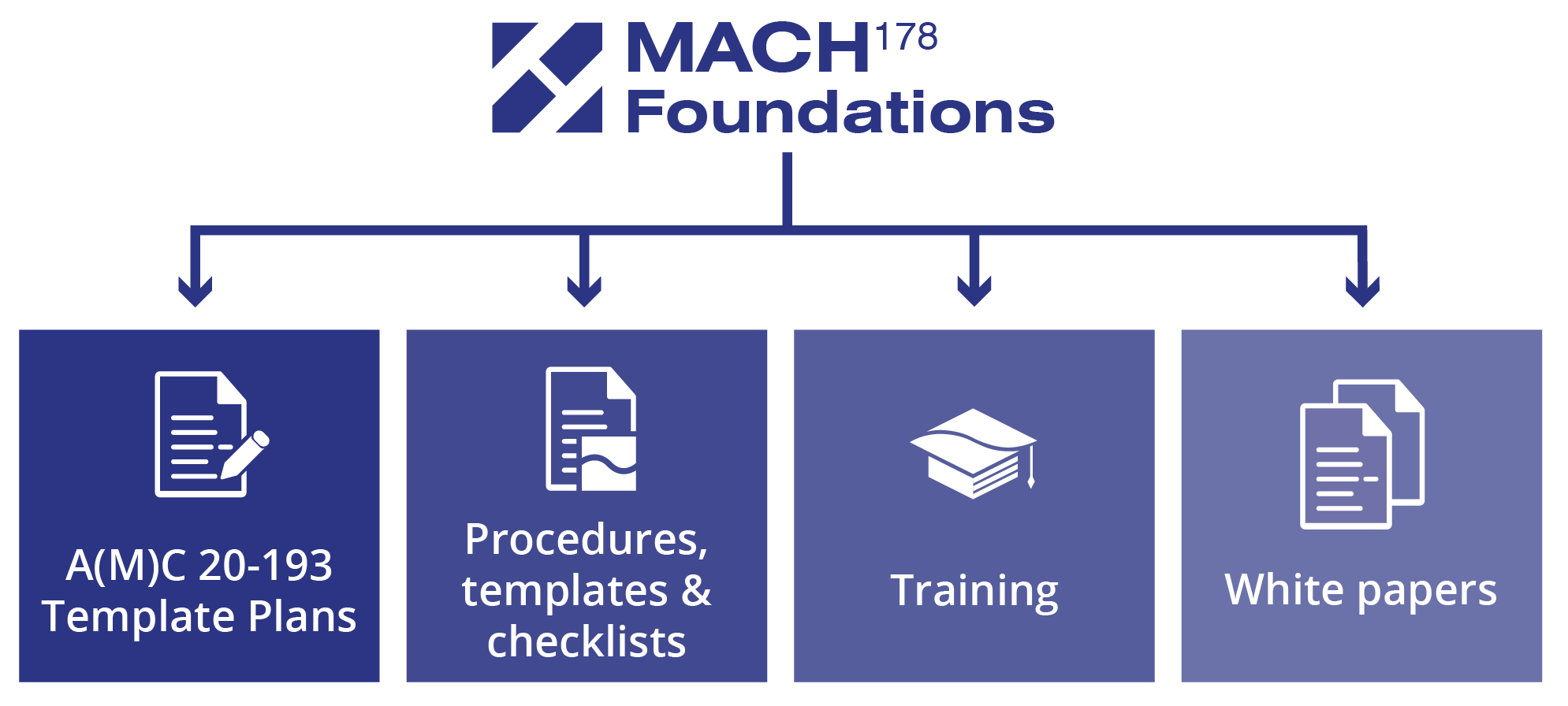
MACH178 Foundations is a library of plans, procedures, checklists and other resources that provide a solid foundation for engineering teams working on multicore DO-178C (AC 20-193 or AMC 20-193) projects, especially when following the MACH178 workflow.

It includes the following documents to support your multicore compliance journey:

  • Template plans for A(M)C 20-193 certification (additions to the PSAC and SVP)
  • Procedures, templates and checklists to support using the MACH178 workflow for A(M)C 20-193 compliance
  • Training resources to help you get started applying the  MACH178 workflow to your project
  • White papers to provide guidance on specific aspects of multicore certification
MACH178 Foundations and the MACH178 workflow are the culmination of tens of person years of work from specialist multicore hardware and verification engineers at Rapita Systems, making it an excellent stepping stone on your compliance journey.

Download Product Brief

MACH178 Tools ensure an efficient, robust and reproducible approach to A(M)C 20-193 verification.

MACH178 Tools include the following:

  • RapiDaemons enable the targeted generation of traffic on shared hardware resources to generate interference during tests, so the impact of interference on platform and software behavior can be analyzed.
  • RapiTest supports writing and executing tests (including the application of RapiDaemons) to analyze and verify software performance.
  • RapiTime supports collecting performance metrics including execution time and values from Hardware Event Monitors during testing, and analyzing the results.
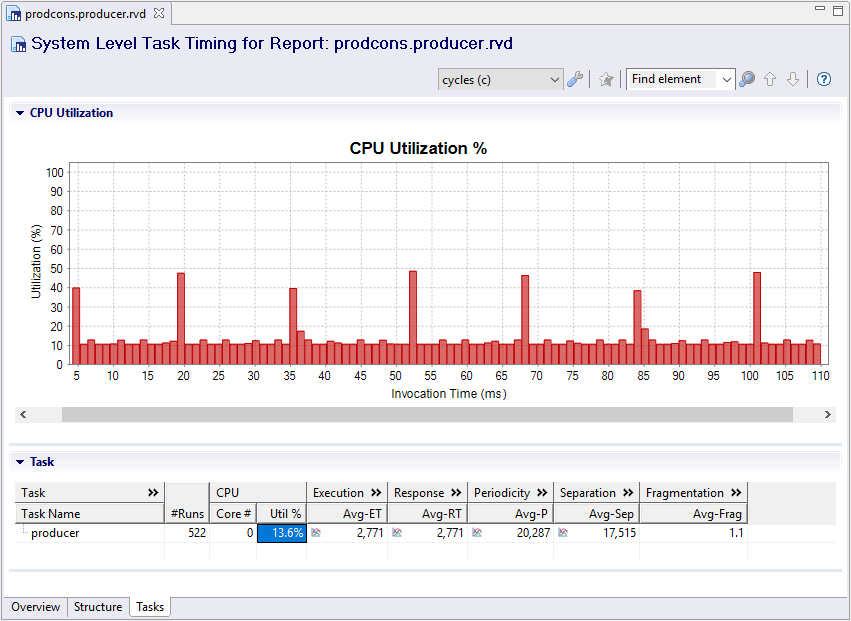
  • RapiTask supports visualizing and analyzing software scheduling.

RapiTest, RapiTime and RapiDaemons, which are used to automate MACH178 processes, are classified as Tool Qualification Level 5 tools as per DO-330. Qualification kits and services provide the evidence needed to qualify their use in MACH178 projects.

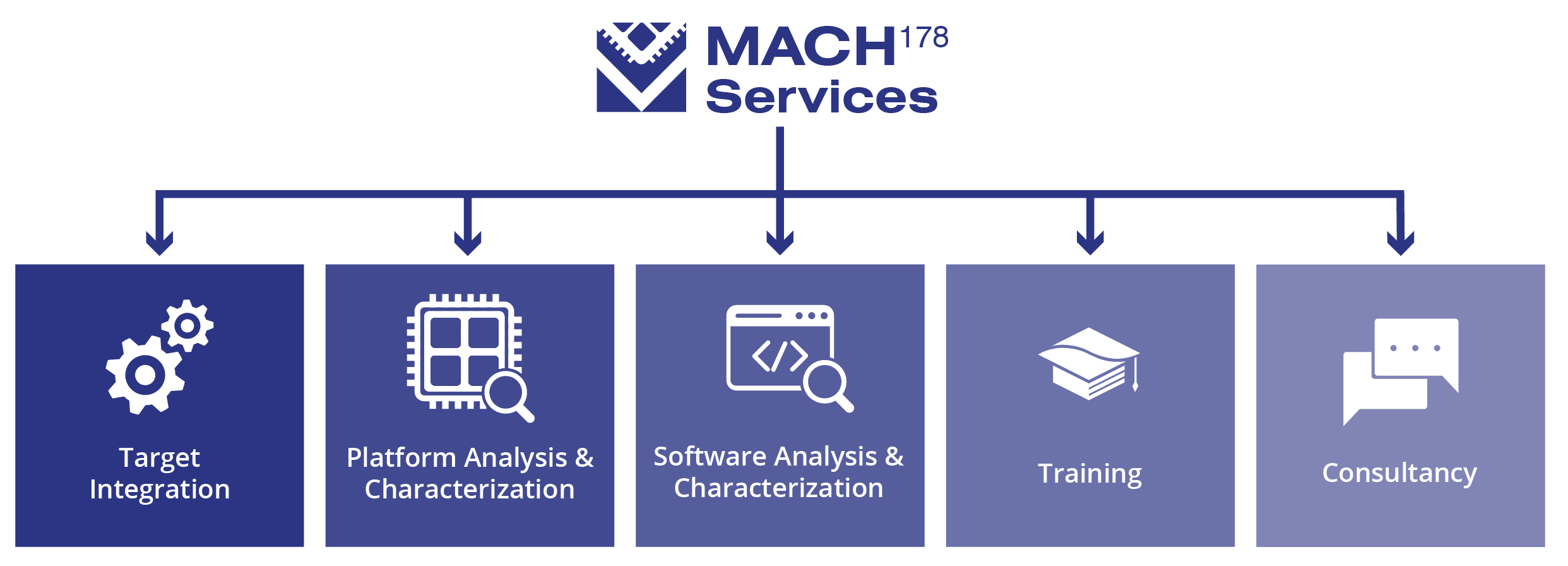
The following services support multicore DO-178C (AC 20-193 and AMC 20-193) compliance using the MACH178 workflow:

  • Tool Integration – this service ensures a robust integration of MACH178 software tools into your platform and development environment so verification activities can be performed efficiently
  • Platform Analysis and Characterization – this service supports the analysis of interference channels and characterization of their potential impact on specific multicore platforms
  • Software Analysis and Characterization – this consultancy service supports your approach to meeting A(M)C 20-193’s MCP_Software_1 and MCP_Software_2 objectives
  • Training – we provide a range of training to support your A(M)C 20-193 compliance journey and application of the  MACH178 workflow
  • Consultancy – we can answer any further questions you have about A(M)C 20-193 compliance with specialist consultancy services

Download Product Brief

Videos


Rapita Systems - Safety Through Quality
00:01:38 | Overview
 
Multicore Avionics Certification for High-integrity DO-178C projects
00:03:02 | Overview
 
Tool automation in multicore timing analysis
00:07:08 | Explainer
 
Custom multicore exports with RVS
00:00:58 | Feature
 

Downloads

  Webinar
Mitigation of Interference in Multicore Processors
  Webinar
A(M)C 20-193 vs AA-22-01
  Webinar
Integrating & verifying time-critical applications on multicore platforms
  Flyer
Software verification for space projects
  Product brief
MACH178 Core Pack: Everything you need to get started with multicore certification
  Product brief
Platform Pack: Supporting platform and configuration evaluation for safety critical projects

Pagination

  • Current page 1
  • Page 2
  • Page 3
  • Page 4
  • Page 5
  • Next page ›
  • Last page Last »

News & Blog

Blog 2022-01-05
Robust partitioning for multicore systems doesn’t mean freedom from interference
News 2020-11-23
Another successful DO-178C Virtual Training Course complete
News 2019-11-22
DO-178 & Multicore Training Bristol 2019
News 2019-10-31
Rapita Sponsor NXP's MultiCore For Avionics (MCFA) Conference 2019
News 2019-07-18
A look back on Rapita's DO-178C training workshop in San Diego
News 2018-11-16
Another successful DO-178C training workshop in Bristol

Pagination

  • Current page 1
  • Page 2
  • Next page ›
  • Last page Last »

Compatibility

We can analyze almost all multicore hardware architectures. See below for a list of components of multicore systems that we have analyzed.

Architectures

We have already analyzed the architectures below and can analyze architectures not on this list:

SoC

Cores

Infineon® AURIX™

Tricore™

NVIDIA® Xavier™

Carmel Armv8

NXP® i.MX 8

Arm® Cortex®-A53

NXP® LS1048A

Arm® Cortex®-A53

NXP® LS1088M

Arm® Cortex®-A53

NXP® LX2160A

Arm® Cortex®-A72

NXP® MPC5777C

PowerPC® e200, PowerPC® e200Z7

NXP® P2041

PowerPC® e500mc

NXP® T1040/2

PowerPC® e5500

NXP® T2080/1

PowerPC® e6500

TI Keystone™ K2L

Arm® Cortex®-A15

TI TMS320F28388D

TI C28x

Xilinx® Ultrascale+® Zynq MPSoC

Arm® Cortex®-A53, Arm® Cortex-R5

Xilinx® Ultrascale+® Zynq RFSoC

Arm® Cortex®-A53, Arm® Cortex-R5

If your architecture is not on the list above, contact us.

RTOSs

We have already analyzed the RTOSs below and can analyze RTOSs not on this list:

RTOS

Bare metal

Blackberry® QNX™

DDC-I Deos™

Green Hills® INTEGRITY®

KRONO-SAFE® ASTERIOS®

Lynx Software Technologies LynxSecure®

SYSGO PikeOS®

Vector MICROSAR

Wind River Helix®/VxWorks®

Custom RTOSs

If your RTOS is not on the list above, contact us.

Boards

We have already analyzed boards from the manufacturers below and can analyze boards from manufacturers not on this list:

Board Manufacturer

Abaco™

Curtiss-Wright®

Mercury Systems®

North Atlantic Industries™

NXP®

Texas Instruments®

Xilinx®

If your board manufacturer is not on the list above, contact us.

Middleware

We have already analyzed middleware from the suppliers on the list below and can analyze middleware from suppliers not on this list:

Middleware Supplier

CoreAVI®

GateWare Communications™

Presagis®

Richland Technologies™

If your middleware manufacturer is not on the list above, contact us.

Frequently asked questions

  • General
  • Multicore timing analysis
  • Interference channel analysis
  • Certification and qualification
  • Compatibility
Expand All
  • Which software tools support MACH178? 
  • Do you support the analysis of GPU-based architectures for multicore timing behavior? 
  • If my RTOS vendor says they provide robust partitioning, why do I need Rapita?  
  • If my RTOS vendor says they provide robust partitioning, why do I need Rapita?

    RTOS vendors may provide partitioning mechanisms for their multicore processors, but these do not guarantee the complete elimination of multicore interference. Instead, they are designed to provide an upper limit on interference, sometimes at the expense of average-case performance.

    In aerospace, these partitioning mechanisms may be referred to as ‘robust partitioning’. The multicore guidance in AC 20-193, AMC 20-193 and CAST-32A identify allowances for some of the objectives if you have robust partitioning in place, but it is still necessary to verify that the partitioning is as robust as it is claimed to be.

    From a certification standpoint, regardless of the methodology behind the RTOS vendor’s approach to eliminating interference, the effectiveness of the technology needs to be verified.

  • Do you support the analysis of GPU-based architectures for multicore timing behavior?

    Yes. We have run projects analyzing the Nvidia Xavier AGX (CUDA) and AMD’s Embedded Radeon E9171 GPU (featuring the CoreAVI Vulkan SC driver).

  • Which software tools support MACH178?

    The following software tools support multicore DO-178C (AC 20-193 and AMC 20-193) compliance using the MACH178 workflow:

    • RapiDaemons enable the targeted generation of traffic on shared hardware resources to generate interference during tests, so the impact of interference on platform and software behavior can be analyzed
    • RapiTest supports writing and executing tests (including the application of RapiDaemons) to analyze and verify software performance
    • RapiTime supports collecting performance metrics including execution time and values from Hardware Event Monitors during testing, and analyzing the results
    • RapiTask supports visualizing and analyzing software scheduling

    RapiTest, RapiTime and RapiDaemons, which are used to automate MACH178 processes, are classified as Tool Qualification Level 5 tools as per DO-330. Qualification kits and services provide the evidence needed to qualify their use in MACH178 projects.
  • Solutions
    • Rapita Verification Suite
    • RapiTest
    • RapiCover
    • RapiTime
    • RapiTask
    • MACH178
  • Latest
  • Latest menu

    • News
    • Blog
    • Events
    • Videos
  • Success Stories
  • Success Stories Menu

    • Airbus Defence & Space
    • BAE Systems
    • Cobham
    • Collins Aerospace
    • Leonardo
  • Downloads
  • Downloads menu

    • Brochures
    • Webinars
    • White Papers
    • Case Studies
    • Product briefs
    • Technical notes
    • Software licensing
  • Company
  • Company menu

    • About Rapita
    • Careers
    • Customers
    • Industries
    • Locations
    • Partners
    • Research projects
    • Contact
  • Discover
    • Multicore Timing Analysis
    • Worst Case Execution Time
    • WCET Tools
    • Code coverage for Ada, C & C++
    • MC/DC Coverage
    • Verifying additional code for DO-178C
    • Data Coupling & Control Coupling
    • DO-178C
    • AC 20-193 and AMC 20-193
    • Certifying eVTOL
    • Certifying UAS

All materials © Rapita Systems Ltd. 2026 - All rights reserved | Privacy information | Trademark notice Subscribe to our newsletter